
Long-term AI memory: what to store, how to retrieve it, and the trade-offs
Learn how long-term AI memory stores facts, episodes, and rules, retrieves relevant context, and balances accuracy, latency, privacy, and cost.

Long-term AI memory becomes a product decision once conversations outlast a single context window. Keeping every prior turn in the prompt raises token use and latency, while repeated summaries can lose details that later decisions depend on. The practical alternative is selective persistence: decide which facts, episodes, and operating rules deserve to survive, place them in storage suited to their relationships, and retrieve only the context needed for the current task. This turns memory from an ever-growing transcript into a system you can govern, budget, and evaluate.

What is long-term AI memory?
Chatbot memory represents durable information an assistant preserves across sessions to personalize answers, maintain continuity, and prevent repetitive queries. In long term memory AI, systems implement cross-session storage and retrieval of facts, interaction history, and operational rules that outlive the prompt tokens of any single turn. Short-term context, by contrast, is confined to the immediate prompt or tool buffer; it resets when a call finishes and becomes increasingly expensive and unwieldy as conversations stretch. The ACM Transactions on Information Systems survey defines agent memory narrowly as information retained within a single trial and broadly as knowledge that spans multiple trials and external sources. Relying on external storage allows agents to maintain continuity without attempting to pack entire histories into every prompt.
To structure durable storage, organize information into three complementary categories: semantic, episodic, and procedural memory. Semantic memory stores stable facts and standing preferences, such as a user timezone, deployment target, or team roster. Episodic memory records discrete events and interaction outcomes: the ticket reopened yesterday, the database migration script that failed, or the exact rationale behind a past configuration change. Procedural memory preserves reusable workflows, guidelines, and behavioral patterns, including coding standards, incident triage checklists, or custom formatting preferences. Semantic memory eliminates redundant questions, episodic memory supplies historical context and accountability, and procedural memory ensures your assistant consistently executes tasks in line with operational standards.
Durable memory provides the greatest return where interactions span days or weeks. In personal assistants, it preserves preferences, recurring tasks, and naming conventions so you never need to repeat setup instructions. In customer support agents, it carries forward account profiles, environment constraints, past case histories, and verified runbooks to accelerate issue resolution and eliminate conflicting advice. In coding copilots, it tracks repository conventions, architectural patterns, dependency constraints, and prior debugging attempts so recommendations fit the active project. Managing AI agent memory as explicit profiles for standing facts, episodic logs for interactions, and stored guidelines for procedure gives your agents persistent context while preventing behavioral drift.
What to store and how to keep it current
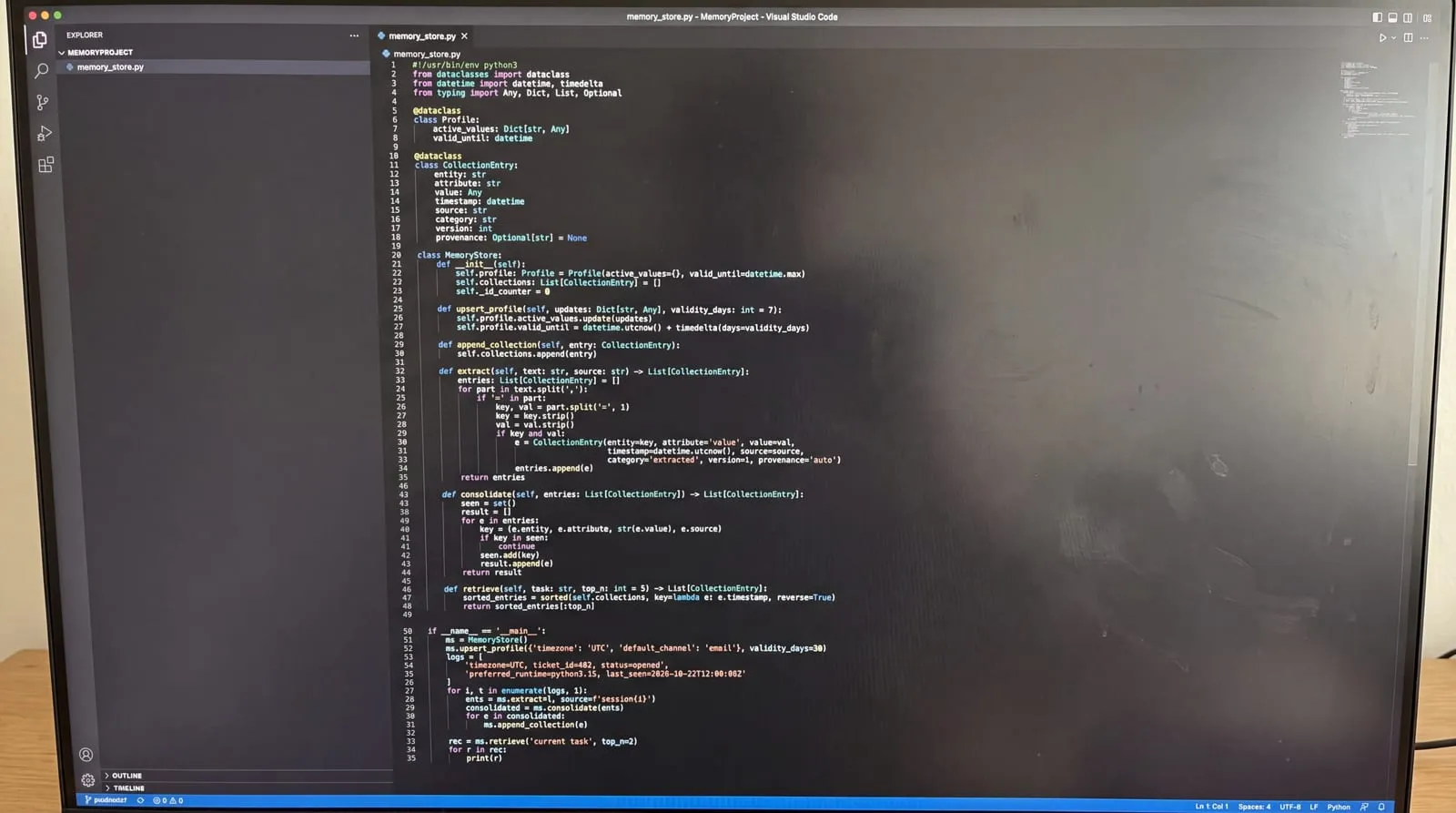
Before storing conversational data, separate current state from chronological history. Store active state in a compact profile and historical context in appendable collections. A profile maintains single active values for standing attributes, such as preferred timezone, primary runtime, or default notification channel, paired with a validity timestamp. Collections capture historical depth across sessions: confirmed facts with version history, episodic interaction logs detailing tool outcomes, and procedural snippets outlining team policies. Every collection entry should record the entity, attribute, value, timestamp, source reference, and category tags, such as recording that a developer prefers UTC, reopened ticket 402, and enforces conventional commits.
Forming durable memory follows a four-step lifecycle across inline hot paths and asynchronous background jobs:
- Extract: Detect candidate facts, preferences, and events from messages and tool outputs using patterns or a lightweight model, emitting structured entity-attribute-value tuples with source evidence.
- Consolidate: Map extracted entities to canonical records, merge duplicate statements, and summarize multi-step interactions through background jobs to prevent fragment bloat.
- Store: Upsert current values into the user profile and append versioned records into collections alongside vector embeddings and retrieval indexes.
- Retrieve: Inject the active profile and fetch top-scoring records for the current task using embedding similarity and namespace filters within a fixed token budget.
Score memories using importance, recency, and strength to govern retrieval priority. Importance reflects domain weight or user emphasis. Recency applies a decay curve so inactive memories fade. Strength increases whenever an item is reaffirmed, referenced, or validated by successful task completion. When facts conflict, never purge older records immediately. End-date the obsolete fact, promote the verified update into the profile, and retain complete provenance so every automated decision remains explainable.
Prevent retrieval bloat and behavioral drift by pairing score thresholds with lifecycle policies. Enforce category-specific expiration windows, prune records that fall below minimum score floors, and condense extended episodic threads at project milestones. Restrict profile overwrites to updates that carry explicit user confirmation or surpass incumbent scores by a defined margin. Archive older records in encrypted storage rather than issuing unmonitored hard deletes.
How is long-term memory stored and retrieved?
The ACM Transactions on Information Systems survey notes that many agents implement memory reading by computing similarity between the task context and stored entries. It also highlights that restructuring text into knowledge graphs supports multi-hop question answering, though maintaining and updating these structures remains an ongoing challenge.
Evaluating primary storage options clarifies the trade-offs between implementation effort and reasoning capability:
| Storage substrate | Primary strengths | Operational limits | Implementation effort |
|---|---|---|---|
| Vector store | Fast semantic matching and top-k retrieval; scales smoothly with approximate nearest neighbor indexing. | Lacks native relational modeling; struggles with multi-hop constraints and precise structural joins. | Low to moderate: requires an embedding model, vector index, and per-user namespace partitioning. |
| Knowledge graph | Explicitly models entities and semantic relationships; enables deterministic graph traversal and multi-hop reasoning. | Requires upfront ontology design, entity extraction, and continuous maintenance to prevent stale edges. | High: demands entity resolution, relationship extraction pipelines, and schema governance. |
| Hybrid (vector and graph) | Combines semantic search for broad candidate recall with localized graph traversal for relational precision. | Greater operational complexity; requires dual-store synchronization and score calibration across modalities. | High: necessitates unified indexing, cross-modal retrieval scoring, and combined query orchestration. |
At inference time, an agent executes a structured retrieval pipeline to surface relevant memories within fixed latency and token constraints:
- Form query: Generate a dense embedding of the current task prompt, applying metadata filters for user namespace, tenant isolation, and memory category.
- Retrieve candidates: Run approximate nearest neighbor search to gather initial top-k records, appending any pinned items from the active user profile.
- Rerank and filter: Score candidates using a cross-encoder or reranking model, adjusting rank values by recency decay, memory strength, and entity deduplication.
- Enforce budget: Select the top-ranked snippets up to a strict token ceiling, formatting each record with concise timestamps and source tags.
- Inject and observe: Append the selected memory block to the model prompt or tool context, logging retrieval IDs to track utility across turns.
Relying on expansive context windows instead of external memory introduces severe operational and cognitive bottlenecks. The ACM Transactions on Information Systems survey reports that long prompts raise compute and latency because attention cost grows roughly quadratically with sequence length, and that models are sensitive to token position, creating a lost-in-the-middle effect. In addition, repeated conversational summarization causes progressive drift, shedding nuanced facts and precision over successive turns. Offloading historical context to external storage and retrieving focused context on demand maintains prompt brevity, contains inference expenditure, and stabilizes reasoning accuracy across indefinitely long horizons.
Hybrid retrieval architectures bridge broad semantic discovery and precise relational constraints without overflowing prompt budgets. The process begins with vector similarity search over the user namespace to locate the most relevant core memories. The system extracts entities from those initial hits and traverses one or two hops across an associated graph index to retrieve directly related facts, active constraints, and procedural rules. A scoring engine fuses semantic similarity scores with graph path metrics, including traversal distance and edge confidence, before applying recency weighting. Filtering for compact, highly connected subgraphs delivers accurate context for multi-step reasoning while preserving strict token limits.
Trade-offs, evaluation, and architecture choices
Evaluating long-term memory requires balancing answer accuracy against token and latency overheads. Redis AI Research reports 86.1 percent task-averaged accuracy for a hybrid that combines raw conversation excerpts with extracted facts, versus 71.2 percent for extracted-only, on LongMemEval Small. In their evaluation runs, the store was reset, past sessions were ingested, a single question was asked, and an official LLM judge scored the answer. The ACM Transactions on Information Systems survey distinguishes direct evaluation of a memory module from indirect task-based evaluation, emphasizing objective metrics such as accuracy, execution time, and hardware cost. Tracking retrieval recall alongside end-to-end task success ensures memory additions deliver measurable utility within budget.
Select your storage and retrieval design based on task demands and enforce rigorous data governance from day one. When applications require exact verbatim recall of past dialogue, retrieve raw conversational chunks. When tasks require multi-hop reasoning or consistent behavioral rules across sessions, deploy hybrid retrieval that pairs extracted profile facts with relational graph links. Implement explicit privacy safeguards: collect explicit user consent prior to persistence, minimize retention to necessary attributes, provide user interfaces to review or edit stored memories, and log every read, write, and purge operation. Encrypt memory stores at rest, isolate data across tenant namespaces, and maintain an immutable audit trail for compliance.
Make memory serve the task
Useful memory is selective. Persist stable facts, consequential episodes, and reusable rules only when they can improve a defined task. Keep current state distinct from history, preserve provenance when records change, and let retrieval thresholds and token ceilings control how much context reaches the model. Choose vector, graph, or hybrid storage according to the reasoning the product requires, rather than treating architectural complexity as a goal. Then judge the design through repeatable tests that pair task success and retrieval quality with latency, token use, and operating cost. A small evaluation can reveal whether a memory adds value, needs better ranking, or should be removed before the system grows. A suitable architecture recalls enough trustworthy context to support the decision at hand while meeting your privacy and budget constraints.